| ||||||||||||||||||||||||
 |
 |
 |
 |
|
 |
|
 |
|
 |
|
 |
|
 |
|
 |
 | ||||||||
 | ||||||||||||||||||||||||
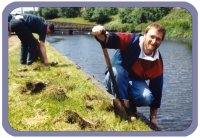
The SocietyThe Birmingham Canal Navigations Society was originally formed as a registered charity in 1968. In 2002 The Birmingham Canal Navigations Society was reconstituted as a Company Limited by Guarantee having a company number of 4306537 and a charity number 1091760. The Societys original aims continue to conserve, improve and encourage a wide range of interests in the 100 mile network of Birmingham and Black Country waterways known as the BCN. A list of the BCNS committee and society officials can be found here. The society also aims to provide a good social environment for its' members and society events have been well attended in the past by both society members and the general public. In addition to this society members have also been kind enough to gove something back, with regular workparties renovating and cleaning various parts of the canal for the benefit of all users, members or public. Forthcoming workparties are also listed in the events section. Introduction to the Birmingham Canal Navigations.Wish You Were Here - Having A Lovely Time On The BCN. Reflectively ..... "That night we had the Bottom Summit all to ourselves and I found this purposeful journeying through the sleeping heart of the industrial Midlands strangely satisfying. Life held nothing better than to stand at the tiller, a warm fire at my feet and a mug of tea to hand, the engine throbbing contentedly as we glided along in the dark ....". "Rural, in the context of the Black Country, meant pastureland mixed with the remains of old mineral workings. New housing estates were fast encroaching on this part of the cut, with the result that, although there was a fair depth of water, heavily loaded boats used to have to creep along because of the danger of hitting obstacles on the canal bed". Two evocatively contrasting images as observed by the same author. Tom Foxon's 1950s view from the tiller is, perhaps, not too far removed from today's scene forty-odd years on, save for the almost non-existence of commercial traffic. Historically ..... Birmingham is widely reputed to have more miles of canals than Venice - the upshot of a chance remark, believed to have been made by a British Waterways official, several years ago. The story is hitherto unproven but the myth has remained and has been used to good effect in much promotional literature! In fact, Birmingham forms a relatively small part of the Birmingham Canal Navigations (BCN), an intricate network of narrow canals situated at the very heart of the Midlands waterway network. The original reason for the BCN's existence was to provide a convenient means of transporting raw materials and goods, produced by local industry, to wherever they were needed. The idea of the new transport system was born in 1767 at a typical hostelry in what was then just the town of Birmingham. The White Swan was a coaching inn and a popular meeting place for the entrepreneurs of the day. Far sighted businessmen rushed to invest in what was seen as a potentially profitable venture and the Birmingham Canal Navigation Company was formed. In later years it was to become known as, arguably, the wealthiest of all the canal companies.
The arrival of the railways in the mid 19th century heralded a change in fortunes for the waterway network nationally. However, the subsequent widespread abandonment, decay and dereliction did not extend to the BCN as a whole, partly due to the fact that local industry was heavily canal orientated. So whilst goods were rail bound for longer journeys, Birmingham and Black Country industry was encouraged to collect cargoes by boat from numerous rail/canal interchange basins which sprang up around the region. Gradually, as carriage by water was superseded by road transport, the BCN fell into a steady decline. Most collieries had been worked out - the transportation of coal being the lifeblood of many BCN carriers - and much of the heavy industrial trade had ceased by the 1930s. A few stalwarts, most notably Thomas Clayton's tar boats, continued to ply their trade between the Midlands and the North until the mid 1960s. Long term neglect was to follow with oily, weed-infested, rubbish-strewn waters becoming commonplace. Through sheer lack of use and subsequent closures much of the BCN mutated into what could be fairly described as a stinking ditch. Fortunately .....
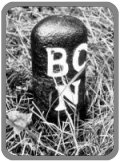
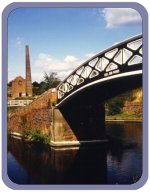
Fiery furnaces belching forth smoke and the once familiar sight of boatmen leading their heavy horses along well-trodden towpaths may have long gone. But clues to a bygone age abound and can be readily apparent to the latter day canal user. Look out for rope marks - worn deep into the parapets of graceful black and white cast iron bridges - evidence of the sheer volume of horse boat traffic. A wealth of history is built into the towpath edge or on locksides, where the coping bricks often bear the name of their maker, a testimony to the workmanship of local craftsmen. The ubiquitous boundary post, once employed to mark the extent of the canal company's land is not such a common sight, most having been buried or taken by souvenir hunters. Ironically ..... Birmingham's Gas Street Basin has undergone something of a radical change in recent years, with tumbledown warehouses replaced by low level offices and trendy pubs, and once derelict land giving way to a glaring multi-storey hotel complex. Traditional, it certainly ain't, but the new age planners can in some way be forgiven as the smart, new appearance coupled with easy access walkways, has rekindled public interest in these once forgotten city centre cuts. Hundreds of boaters must pass this way each year, but sadly only a small percentage take the trouble to stay and discover for themselves exactly what the BCN has to offer. To many the BCN Main Line - providing just fifteen miles of comfortable cruising into Wolverhampton - is seen as a necessary evil: a link with the green pastures of the Staffordshire & Worcestershire Canal which must be traversed in the shortest practical time. For this and other reasons the Birmingham Canal Navigations are largely underused and undervalued canals. approximately three quarters of which were designated Remainder Waterways under the provisions of the infamous 1968 Transport Act. As such, the majority of the system is required only be maintained to a minimum safety standard by British Waterways due to increasingly acute financial constraints imposed by central government. Like it or not, the canals of Birmingham and the Black Country remain under constant threat and are available today for pleasure cruising only through the concerted and continued efforts of local waterway enthusiasts. Despite recent favourable developments - the re-opening of Dudley Tunnel to through navigation, a new lease of life for the Walsall Town Arm and the construction of the Birmingham & Black Country Cycleway for example - the system cannot by any means be considered "safe" and a consistent vigil must be kept to ensure that the BCN remains for the benefit of all users. Therefore, the "use 'em or lose 'em" adage has to be good advice in order to retain this priceless legacy of the industrial revolution.
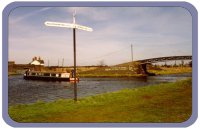
Such is the complexity of the network that a major project undertaken by the BCN Society over a ten year period has been the placement of direction signposts at every one of the BCN system's twenty-seven navigable junctions. This being a direct response to all those boaters and walkers who complained of getting lost when straying from the "safety" of the main lines! Generally speaking, the conglomeration of canals to the north east side of the Birmingham Level is referred to as the "Northern BCN". Names such as Curly Wyrley, Tame Valley and Daw End conjure up images of a peaceful countryside haven, but were all once part of a thriving industrial workaday community. Today, the Northern BCN exists as a miscellany of light industry and urban dwellings in its lower reaches, metamorphosing into almost unbelievable lush, tranquil settings, progressively towards its uppermost terminus and feeder reservoir at Chasewater. This is the BCN at its historic and rural best. So why is it that despite the eminent rustic charm and pastoral delights of the Rushall Canal, Anglesey Branch and Cannock Extension, boaters seem to favour the relatively rugged townscapes of the main lines? It is widely conceived that the answer lies in the missing connection with the rest of the canal system. In this context it is pleasing to note that the local restoration movement is alive and kicking. The Lichfield & Hatherton Canals Restoration Trust is confident that plans to reinstate links with the Coventry Canal via the Ogley Branch of the Wyrley & Essington (the "Lichfield" Canal) and the Hatherton Branch with the Staffordshire and Worcestershire Canal are beginning to bear fruit. The major threat to the whole restoration programme, the proposed construction of the Birmingham Northern Relief Road, has recently been given the ministerial nod of approval with no provision for the continuation of navigation. Trust supporters are currently attempting to lobby the powers-that-be in the hope that their work will be given the due consideration it deserves and that the restoration plans may continue unabated. An equally pressing problem presents itself with the imminent widening of the M6 motorway, the plans for which do not include for the continuation of the restoration of the Hatherton Branch Canal, presently culverted near Calf Heath. A long term project? Maybe, but the provision of an access/exit route will no doubt breathe new life into the Northern BCN and open up a further two possible cruising rings. Meanwhile to the south, following a long period of careful planning, the Lapal Canal Trust has made measurable headway with plans to extend the presently truncated Dudley No.2 Canal. A ceremony to mark the official start of restoration took place in early March 1997 and the Trust plans to eventually reinstate the entire line from Hawne Basin - the present terminus - through to the Worcester & Birmingham Canal at Selly Oak. Work has already commenced with the restoration of the 800 yard Leasowes Embankment, one of the largest of its type ever constructed. It is envisaged that not only will both projects expand possibilities for cruising but will attract considerable prestige and additional revenue to the areas concerned. Both restoration groups, it must be said, have been supported by a healthy contingent from the Waterway Recovery Group.
Conclusively ..... Reports would suggest that a reasonable percentage of visitors to the Black Country National Waterways Festivals in both 1991 and 1996 took the opportunity to discover the "less accessible" areas of the BCN for themselves. The Titford Canal at 511 feet is the summit level of the BCN, but suffers from perennial water shortages, leading to lack of use. The situation has now been taken in hand by representatives of BCNS, IWA and Coombeswood Canal Trust, engaged in talks with BW. It is pleasing to report an overall positive outlook with general dredging and tidying up work around the area of Titford Pools, together with possible plans to reinstate the back-pumping system on the six lock Oldbury flight. From the typically urban contours of the Walsall (currently the focus of much local attention) and Wyrley & Essington canals, to the arrow-straight Tame Valley and Rushall canals. The waterways of the BCN are all worthy of retention, but will rapidly decline and face ultimate consignment to the history books if we cannot demonstrate their full potential as living, cruising waterways. The recent sad loss of the Ridgeacre Branch is, indeed, a case in point. Birmingham Canal Navigations - three words guaranteed to make your average boater cringe and head feverishly for the weed-hatch. Just as sure as exaggerated tales of 'bandit country' infest boat clubs and canal societies throughout the land like weed growth on the 'ampton pound. Heed the tales of horror at your own peril! If your perception of the BCN is that of a linear rubbish tip, then please, take a word of advice - come and see for yourself - experience the delights of the real BCN. You are assured a warm welcome. Views from around the BCN can be seen in the gallery. | ||||||||||||||||||||||||
|
Home | The BCNS | Boundary Post Journal | Pumphouse HQ | Workboat Phoenix | Events | Photo Gallery | Sales | Membership © The Birmingham Canal Navigation Society - 2002. | ||||||||||||||||||||||||